Aylus Great Neck Branch Volunteer in Field 10 and energy and nature center in Jones Beach on 1/10/2026 (56th)
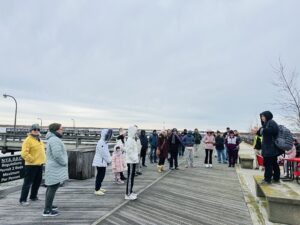
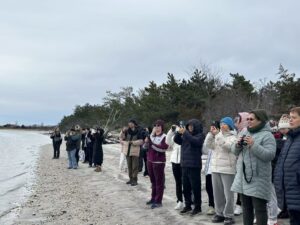
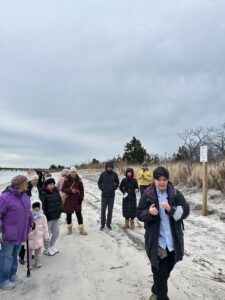
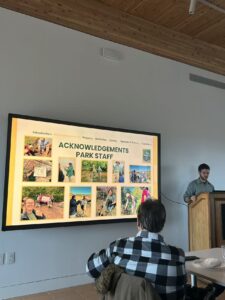
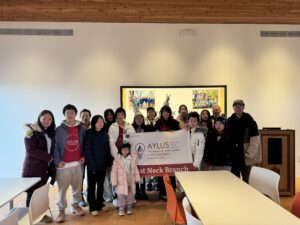
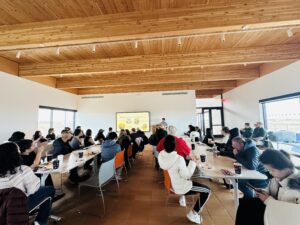
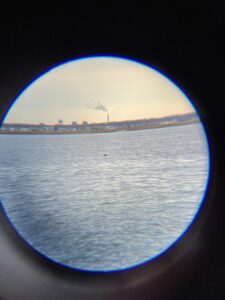
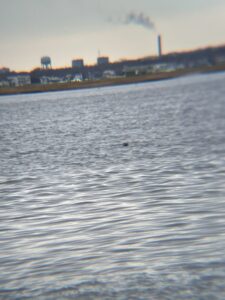
On 1/10/2025, Aylus volunteers went to Field 10 and energy and nature center in Jones Beach for our first official Stewardship meeting of the year from 9:30am to 12:30am (3 hours). First, the volunteers gathered at Field 10 of Jones Beach and met at the dock. There are some shells on the dock, and the park staff explained that these shells were there because seagulls and other seabirds drop the shell there to eat them. We are there today to observe seals, and there was a stand informing people about different types of seals on the dock. After everyone was there, the volunteers headed toward the bay to observe the seals. While we’re walking on the beach, the park staff, who is very experienced and an expert on seals, explained that the white sand of the beach are mainly quartz. Then, she scooped a small amount of the black sand on the beach and showed us that it was actually a mix of black and red sand. The black-looking stripes are made up of magnetite and garnet gemstone(red), which were brought by glaciers a long time ago. We even saw footprints of a raccoon on the sand on our way, it was pretty cute. When we finally were at the spot where we are closest to the seals, the park staff explained a little more. There’re seals that appear more often and seals that rarely appear; they are here at Jones Beach for its fish; seals are usually here from November to April, then they’re back to the north when the water gets warmer; Harbor seals have dog-like heads, while gray seals have horse-like heads. Although we can already see the seals’ black round heads in the water that look like spots, it would be clearer if you use a monocular telescope. I took some photos from the monocular and put it at the end of the report, but it’s clearer if you just observe it with eye through the monocular, and I could actually see its head. It is a truly amazing experience to observe wild seals. By the way, field 10 is actually opened for observing seals for a few months and it doesn’t charge parking fees. However, it’s important to know the tide schedule and the weather; because one, you can’t really walk on the beach if there’s a high tide; and two, it would not be ideal to see the seals if it’s very windy. The volunteers drove to the energy and nature center after the observation and had a light lunch with some sandwiches, energy bars, cookies, hot coco, coffee, and other drinks. After that, park staff Michael and Alexa gave everyone a speech about what we did last year, all the progress(including 14,000 lbs of invasives removed that other volunteers had also made contributions and many natives planted in warm houses and then sent to other state parks), our events (include some in the weekdays that Aylus didn’t participate in), and active members that are adults last year(with James being the most active). The first official Stewardship meeting of the year ended with everyone taking a photo and filling out new sheets for the year. State parks volunteer activities are truly helpful and meaningful events where you can learn about nature and make contributions to the environment.
Members who participated include: Yingxiang Liu (3h), Yuya Liu (3h), Felicia Liu (3h), Sumeng,Liu
(3h), Alice Wang (3h), Aimee Wang (3h), Elly Sun (3h), Sherry Xia (3h), Eric Xia (3h), Chloe Wang(1h) Reporter: Felicia Liu