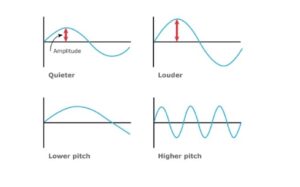
Sound is the energy produced when objects vibrate. As an object moves back and forth quickly, it causes the surrounding air to vibrate too, sending that energy outward until it reaches our ears and is perceived as sound. Pitch depends on frequency — how fast something vibrates — while volume depends on amplitude, or the size of the vibration.
Humans have explored this relationship between vibration and sound for thousands of years. Early instruments began with percussion — striking stone, wood, and animal hide. Later, stretched strings gave rise to stringed instruments, and blowing air through hollow tubes led to instruments like flutes and horns. From ancient bone flutes to the modern violin and piano, the development of musical instruments reflects humanity’s long history of learning to control vibration.
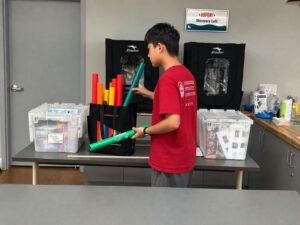
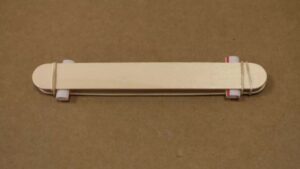
At this station, Brian guided visitors through several hands-on demonstrations, including striking a tuning fork to see its vibrations ripple through water, plucking rulers of different lengths and materials to compare pitch, and building a simple homemade instrument — a “sound sandwich” made from craft sticks, rubber bands, and straws — that visitors could blow into like a harmonica. Adjusting the straws’ position let visitors hear firsthand how changing an instrument’s shape changes its pitch, echoing the same principle musicians have used for centuries to tune stringed instruments.
Through this activity, visitors experienced a small piece of the same physics that has shaped musical instruments throughout human history.
Time: 10:30 am- 3:30 pm (5 hours) Brian
Reporter: Victor